

The Complete Buyer’s Guide for Choosing the Right Slab Countertop
A slab countertop is one of the most visible surfaces in a home and one of the most permanent decisions in a kitchen or bathroom remodel. Unlike paint or hardware, it is not easily changed once it is fabricated and installed. Getting it right means understanding how each material performs under real kitchen conditions, what different finishes require day to day, and what has to be in place before an installer can show up.
This guide walks through everything a homeowner needs to make a confident countertop decision, from cost and material selection to color, finish, and installation prep.
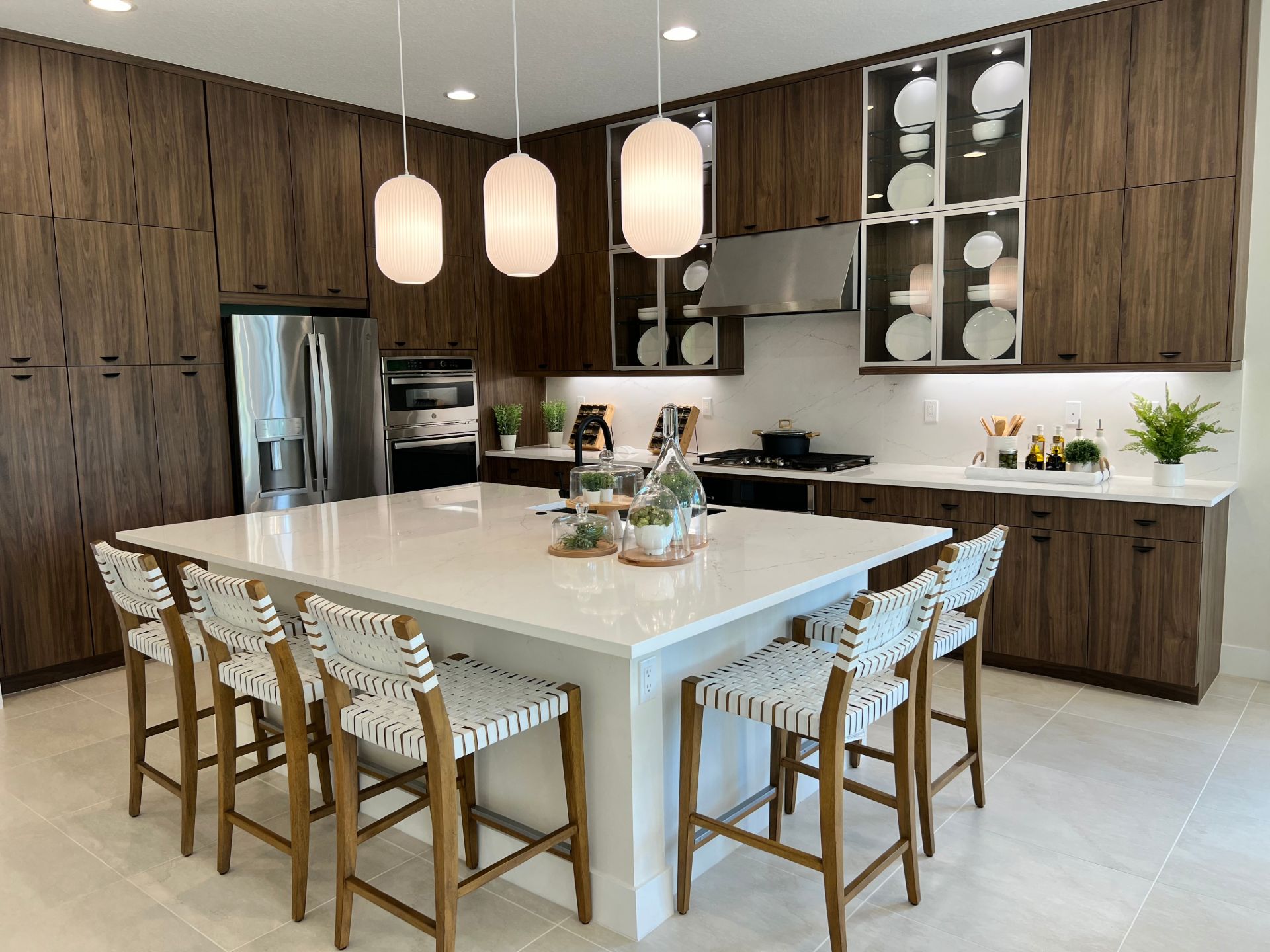
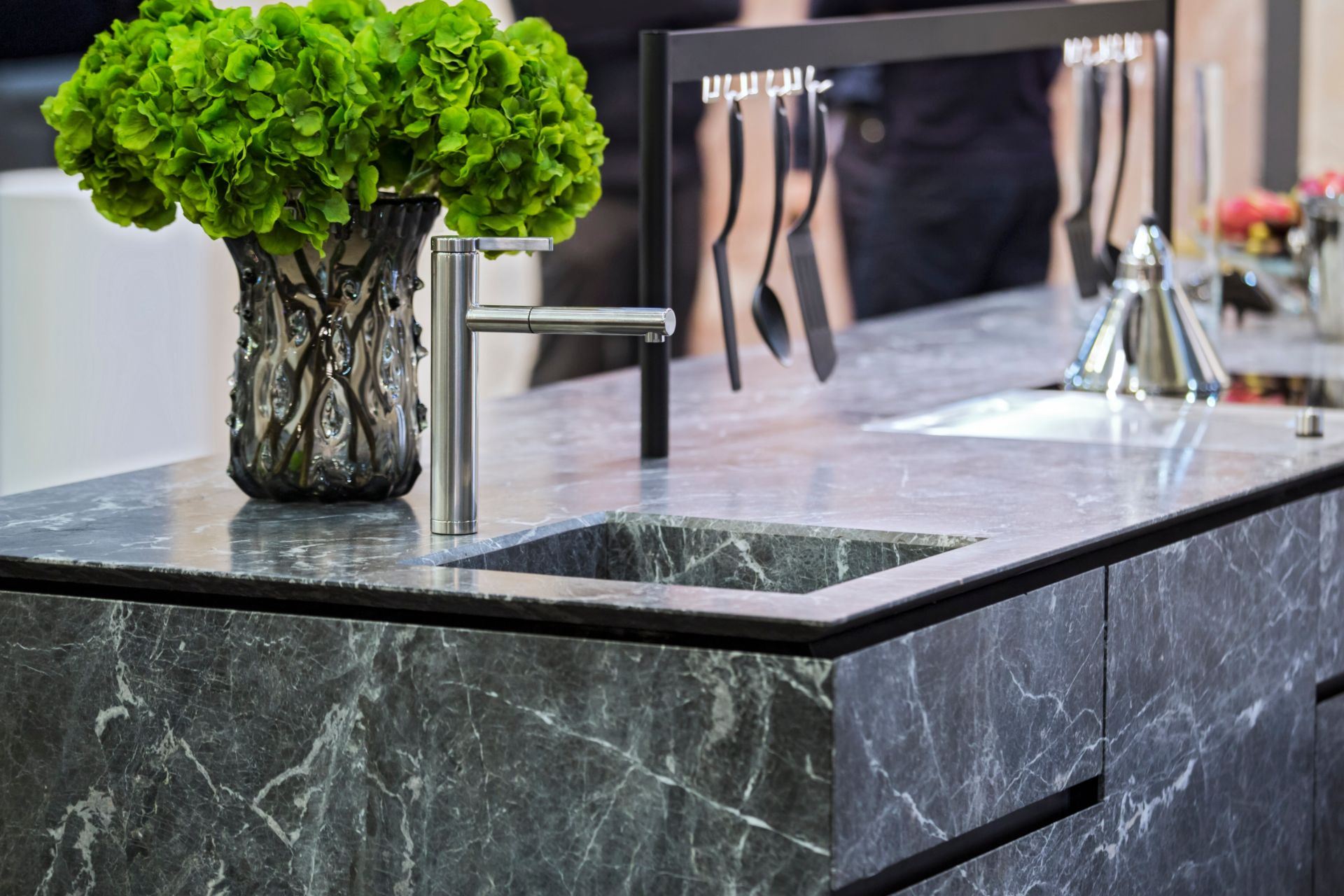
What Does a Slab Countertop Cost?
Slab countertops are a long-term investment, and the price range is wide enough that budget is the right place to start. According to Angi, professional countertop installation typically costs between $1,852 and $4,461, with prices ranging from $40 to $150 per square foot installed, covering the slab material, templating, fabrication, and installation. Material is the dominant cost variable, though finish choice and the visual character of a specific slab also affect where you land within any material’s price range. Individual material cost ranges are covered in the material section below.
Choosing a Slab Countertop Material
Slab countertops are available in natural and engineered stone. Natural options include granite, marble, and quartzite, and each slab is unique in color, veining, and patterning. Quartz is engineered from ground quartz particles bound with resin, manufactured to consistent dimensions and appearance. Neither category is inherently better. The right choice depends on how you use your countertops, how much variation you want in the finished surface, and how much maintenance you’re willing to commit to.
Granite Countertops
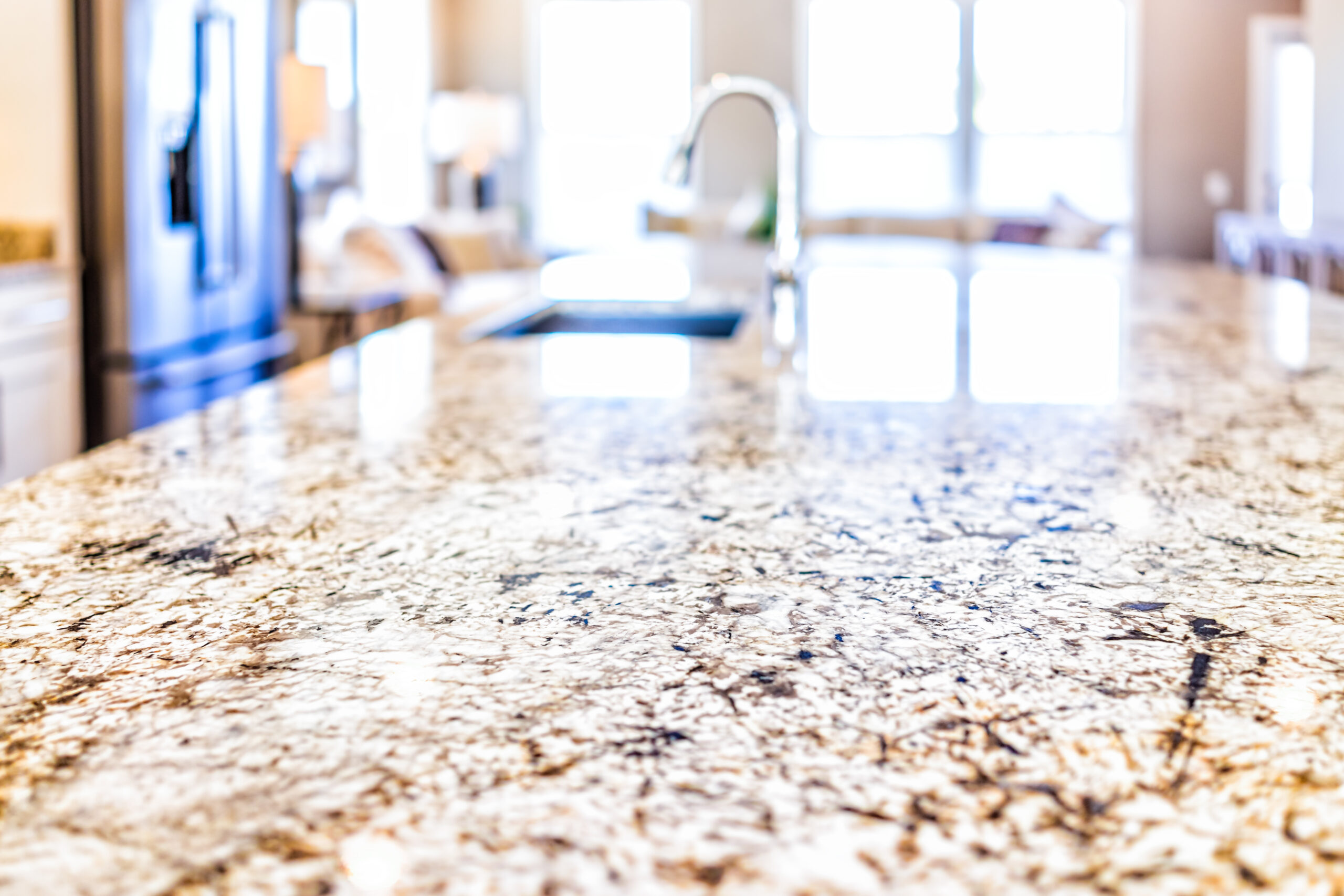
Granite is an igneous rock whose mineral composition gives it its characteristic speckled or flecked appearance and makes it one of the hardest natural stones used in countertops. It is highly resistant to scratching and heat. Granite’s color range spans from quiet neutral tones to dramatic blacks, blues, and golds, and the variation between slabs is generally more subtle than in marble, making it easier to predict what the finished countertop will look like before you commit.
Most granite countertops benefit from periodic sealing, though many slabs arrive factory-treated with a resin coating that provides initial protection. Granite costs typically run $40 to $60 per square foot, with installation adding to that total.
Marble Countertops
Marble is a natural stone known for its veining, which forms as mineral impurities move through the stone, and no two slabs carry the same pattern. It is softer than granite and more susceptible to scratching, etching, and staining. Scratching occurs from abrasive contact with knives, pans, and cookware. Etching is surface dulling caused by contact with acidic substances such as citrus juice, vinegar, and wine. Staining occurs when liquids penetrate the stone’s porous surface and leave a mark that sealing alone may not fully prevent.
Over time, these effects accumulate into a patina: a gradual softening and dulling of the surface that many designers consider part of marble’s character, though buyers who want the surface to stay looking new will find it difficult to maintain in an active kitchen. Marble is often a better fit for lower-traffic applications like bathroom vanities, where the aesthetic payoff is high, and the exposure to kitchen acids is limited. Material costs range from $40 to $100 per square foot, depending on grade.
Quartzite Countertops
Quartzite is a metamorphic rock that begins as sandstone and transforms under heat and pressure into a much harder material. It’s harder than granite and significantly harder than marble, which makes it highly resistant to scratching and abrasion under daily kitchen use. Quartzite is frequently confused with quartz, but the two are unrelated. Unlike quartz, quartzite is a natural stone that requires sealing, varies in color, veining, and patterning from slab to slab, and can etch when exposed to acids, though generally less so than marble.
Its appearance often resembles marble, with flowing veins and movement, which appeals to buyers who want the look of marble without marble’s vulnerability. Installed costs typically range from $80 to $220 per square foot, making it the most expensive of the four materials.
Quartz Countertops
Quartz is an engineered product manufactured from ground quartz aggregate bound with resin, then pigmented and surface-treated to a consistent appearance. Because the surface is non-porous, quartz does not require sealing and resists staining from most household liquids, but it’s not accident-proof. Though the resin binder makes it more vulnerable to heat than natural stone, prolonged direct heat exposure can discolor or crack the surface.
The engineered manufacturing process allows for colors and patterns that don’t exist in nature, though it lacks the depth and variation of natural stone. It’s possible to create solid whites, uniform grays, and concrete-look finishes, making it a versatile option for contemporary and minimalist kitchens. Installed costs run $50 to $200 per square foot, with entry-level series competitive with granite and premium designer series approaching marble pricing.
Finish Options
The finish applied to a slab affects how it looks, how it performs day to day, and how much care it requires. All four materials are available in multiple finishes, though not every finish is appropriate for every material.
| Finish | Description |
|---|---|
| Polished | A polished finish produces a reflective, glassy surface that brings out the depth of color and the contrast of veining in natural stone. It is the most common finish for kitchen countertops, though polished surfaces show fingerprints, water spots, and smudges more readily than matte alternatives and are the most vulnerable to etching from acidic substances, particularly on marble. |
| Matte and honed | A matte or honed finish stops the polishing process before the surface reaches full reflectivity, producing a flat, soft sheen that reduces the visibility of fingerprints and water spots. On marble, it makes etching less visible, though the trade-off is that honed natural stone is more porous than polished stone and requires more attentive sealing. |
| Leather and brushed | A leathered finish is created by running diamond-tipped brushes across the surface of the stone, producing a slightly textured, low-sheen result that hides fingerprints and minor scratches better than polished stone. It is most commonly applied to granite and quartzite; it is not appropriate for marble, which is too soft to withstand the brushing process without damage. |
| Concrete | A concrete finish is specific to engineered quartz and mimics the flat, slightly mottled appearance of poured concrete. It is a manufacturing finish rather than a surface treatment, available on select quartz products, and suits buyers who want a utilitarian or industrial aesthetic without the maintenance requirements of actual concrete. |
Advice Regarding Color, Pattern, and Veining
Choosing a slab color involves more variables than choosing a paint color or a fabric swatch, because the material you’re looking at will behave differently under different light conditions, at different scales, and in relation to the other surfaces in the room.
See Natural Stone in Person
A sample chip communicates color and approximate pattern, but cannot show you how a specific slab will look across a full countertop. Two slabs with the same product name can vary significantly in veining density, background color, and movement. For granite, marble, and quartzite, the standard practice is to view and select the actual slab you want at the distributor’s warehouse, not just a sample. What you approve at the warehouse is what gets fabricated for your countertop.
Light Changes Everything
A slab that looks warm and gold under warehouse fluorescents may appear cooler and more gray in a north-facing kitchen with limited natural light. If possible, view slabs under lighting conditions similar to your kitchen, or photograph the slab outdoors in indirect light to see its true color. Pay attention to how the slab’s undertones, whether warm, cool, or neutral, will coordinate with your cabinet finish, floor material, and wall color to avoid clashing with them.
Consider Scale and Pattern Density
A slab with large, sweeping veins will dominate a small kitchen and can feel busy against patterned tile or complex cabinet detailing. In those settings, a quieter, more uniform slab tends to work better, letting the cabinetry or other design elements take visual priority. In a simpler kitchen with flat-front cabinets, neutral tile, and minimal ornamentation, a slab with dramatic movement has room to become the focal point without competing with anything around it. The right choice depends on what role you want the countertop to play: background surface or statement piece.
Dark vs. Light
A white or cream countertop will show coffee rings, water spots, and food residue more readily than a mid-tone gray or a darker stone. Heavily speckled patterns tend to camouflage crumbs and minor staining better than slabs with large open areas of solid color.
Plan Seam Placement and Vein Patterns
On countertops that require multiple slabs, including L-shaped kitchens and large islands, seams are unavoidable. Where seams fall in relation to veining patterns affects how visible they are. A seam that cuts across a strong vein will be more noticeable than one placed in a quieter area of the stone. Discussing seam placement with your fabricator during the selection process, rather than after templating, gives you more control over the finished result.
Exploring Edge Profiles
The edge profile is the shape applied to the exposed front edge of the countertop during fabrication. It affects the countertop’s visual weight, how it relates to the cabinet below, and how easy it is to keep clean. Simpler profiles are generally more chip-resistant; ornate profiles with detailed edges, such as ogee, are more vulnerable to chipping at their contoured surfaces. Most profiles are available in all four materials, though highly ornate profiles require thicker slabs to execute properly.
| Profile | Appearance | Best For | Trade-off |
|---|---|---|---|
| Eased | Flat face with lightly softened top and bottom corners | Contemporary and transitional kitchens; most versatile profile | Minimal visual interest; works best when other design elements in the kitchen provide visual contrast |
| Beveled | Angled cut along the top edge, creating a visible diagonal face | Transitional and modern kitchens; adds definition without ornamentation | Bevel can collect crumbs and residue along the angled face |
| Bullnose | Fully rounded top edge, curving down to meet the cabinet | Traditional and casual kitchens; softer, less formal look | Rounded profile reduces the perceived thickness of the slab at the edge |
| Ogee | S-curve profile with a concave lower section and convex upper section | Traditional and formal kitchens; high visual detail | Complex profile amplifies busy veining; requires a 3 cm slab (the thicker of the two standard residential options); more prone to chipping and harder to clean in the crevice |
| Waterfall | Slab continues vertically down the cabinet face to the floor | Contemporary and minimalist kitchens; strong architectural statement | Requires additional slab material; seam at the corner joint is visible on natural stone |
| Mitered | Two slab pieces joined at 45-degree angles to create a thick-edge appearance | Contemporary kitchens; creates the look of a very thick slab without the weight | Requires precise fabrication; mitered seam must be carefully matched on natural stone |
Where to Use Slab Countertops
Slab countertops appear most often in kitchens and bathrooms, but they work in any space where a durable, finished surface is needed. Material choice matters more in some rooms than others, depending on exposure to moisture, heat, and acids.
| Room | Recommended Material | Why It Works |
|---|---|---|
| Kitchen countertop | Granite, quartz, quartzite | All three handle heat, cutting, and daily food prep well. Quartz requires no sealing and offers a consistent appearance. Granite and quartzite reward regular sealing with long-term durability. |
| Kitchen island | Any; quartz or granite preferred for high-use islands | Islands typically see heavier use than perimeter counters. Quartz and granite’s combination of hardness and low maintenance makes them practical choices where the surface takes daily punishment. |
| Bathroom vanity | Marble, quartz, granite | Lower exposure to kitchen acids makes bathroom vanities an appropriate setting for marble. The limited surface area reduces maintenance demands. Quartz is practical for shared or high-traffic bathrooms where ease of cleaning is the priority. |
| Laundry room | Quartz, granite | Laundry rooms benefit from a non-porous, easy-to-clean surface that resists detergent and water exposure. Quartz’s non-porous surface is particularly well-suited. Natural stone is viable but requires consistent sealing given the frequent moisture exposure. |
| Outdoor kitchen | Granite, quartzite | Both materials handle UV exposure and temperature variation better than quartz, whose resin binder can degrade with prolonged sun and heat exposure. Confirm outdoor suitability with your specific slab selection, as not all natural stone products are rated for exterior use. |
| Fireplace surround | Any | Lower functional demands make this an appropriate place to use a material for its aesthetic rather than its durability. Marble’s veining and warmth work well in this application, and heat exposure is indirect rather than sustained. |
What to Address Before Installation
Slab countertop installation involves several decisions and site conditions that need to be addressed before the template appointment. Resolving these in advance prevents delays and avoids changes after fabrication has begun.
| Question | What to Know |
|---|---|
| Are your cabinets level? | Countertops are templated and fabricated to fit the actual cabinet layout. Cabinets that are significantly out of level may require shimming before the template appointment. Addressing this before the fabricator arrives prevents fitment problems during installation. |
| What sink are you installing? | Sink style affects the countertop cutout. Undermount sinks require the cutout to be finished on the underside, which adds fabrication complexity. Farmhouse (apron-front) sinks require a specific front cabinet modification and countertop notch. Confirm your sink selection and have the sink on hand, or at a minimum, confirm its dimensions, before the template appointment. |
| Where do you want seams placed? | On runs longer than a single slab, seams are necessary. You can influence where they fall: away from the sink, in a less-trafficked area, or aligned with a natural break in the veining. Communicate your preferences before fabrication begins. After the slab is cut, seam placement cannot be changed. |
| Is the existing countertop being removed? | Removal of the existing countertop is a separate step from installation and should be scheduled in advance. If the existing countertop is tile set in mortar, removal can affect the cabinet substrate below and may require additional prep work before templating. |
| What is your backsplash plan? | The countertop is typically installed before the backsplash. If you plan to tile the wall between the countertop and the upper cabinets, the tile installer will need the countertop in place first. Confirm the sequence with your installer so trades don’t get scheduled out of order. |
| Will the countertop extend to a cooktop or range cutout? | Cooktop cutouts are fabricated from the template and must match the cooktop’s specifications exactly. Have the cooktop selected and its cutout dimensions confirmed before the template appointment. If the cooktop has not yet been purchased, the cutout cannot be accurately fabricated. |
| Does your natural stone need sealing before use? | Most granite and quartzite countertops benefit from sealing before first use, and marble should always be sealed. Sealing should happen after installation and before the countertop is put into service. Confirm with your installer whether sealing is included in the installation scope or whether you need to arrange it separately. |
Ready to Choose Your Slab Countertop?
Builders Interiors carries granite, marble, quartzite, and quartz from Arizona Tile, Caesarstone, LX Hausys, and MSI, with hundreds of options across all four materials available at our Woodinville showroom. Seeing slabs in person before you commit is worth the trip: color, veining, and movement don’t translate fully to a screen.
Schedule a free consultation, and we’ll help you narrow the field, coordinate your selection with your cabinet and floor finishes, and give you an accurate quote for your project.